





.webp)
.webp)

.webp)

In June, the Food and Agriculture Organization of the United Nations (FAO) released the "Food Outlook" report, which included a special analysis of the global fertilizer market. The report integrates the full-year statistical data on production, application, and trade for 2025, while updating the latest changes in energy raw material prices and global agricultural inputs circulation for the first half of 2026. It makes systematic predictions for the fertilizer market trends from June to November, comprehensively and objectively analyzing the current operating characteristics of the global fertilizer industry.
I. Capacity steadily expanding, energy becoming the core cost variable
Fertilizer production costs are deeply tied to natural gas prices. In 2026, global natural gas supply and demand tightened, with European gas price fluctuation ranges significantly widening, continuously driving up production expenses for fertilizer factories at home and abroad.
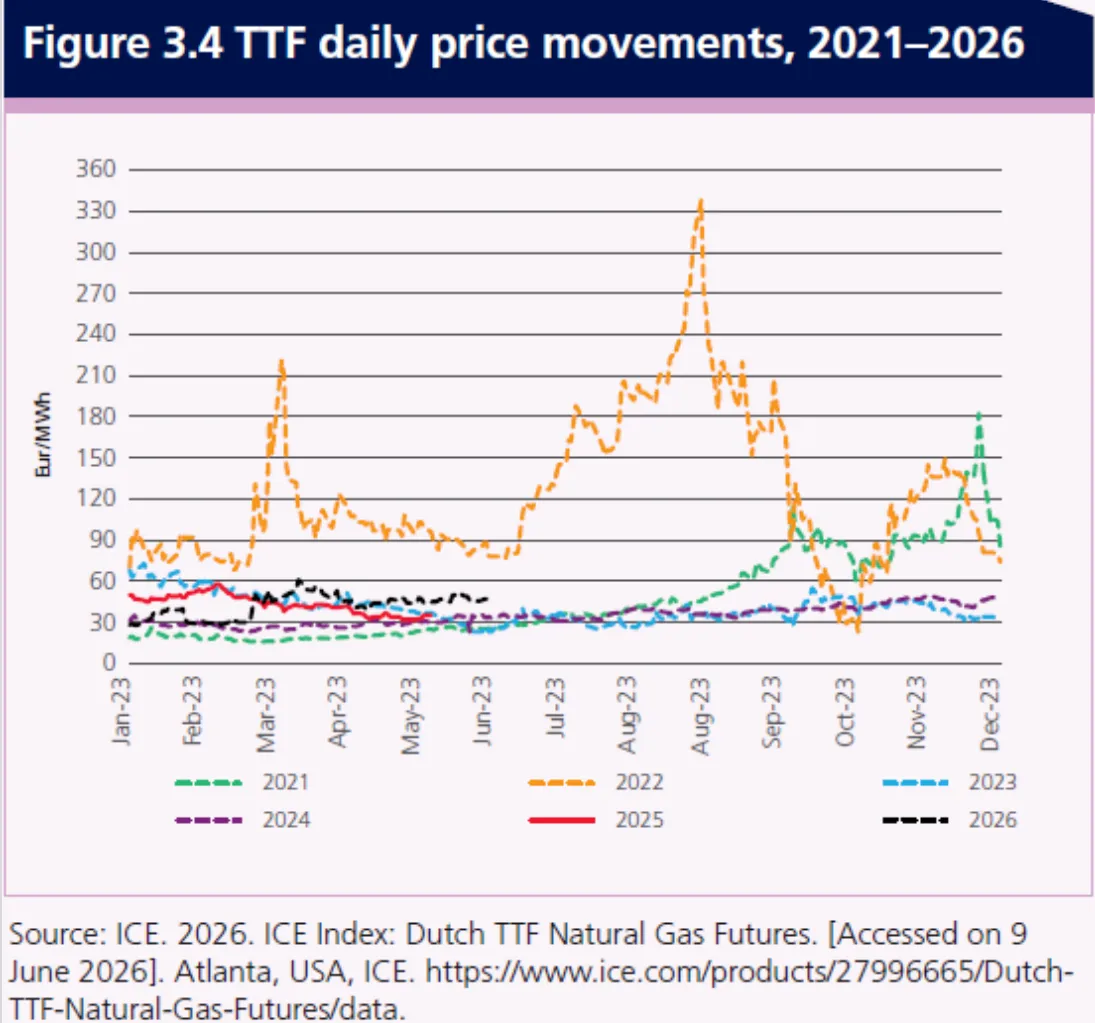
Ammonia is the basic raw material for nitrogen fertilizer. Global annual ammonia synthesis production exceeds 190 million tons, with high energy consumption in the production process, and energy prices directly determine production costs and regional distribution. Resource endowments have created differentiated production patterns: ammonia plants are concentrated in natural gas-rich regions; domestically, stable ammonia production relies on coal; India relies on imported LNG to maintain capacity.
In 2025, global ammonia synthesis production was 192 million tons, a year-on-year increase of 1%; total urea production reached 204 million tons, setting a historic high. In the same period, global MAP and DAP Total ammonium phosphate output reached 68 million tons, a slight year-on-year increase of 1%; potash fertilizer output reached 77 million tons, also setting a new historical record. Production capacity in Belarus and Russia steadily increased, while Chile's salt lake industry shifted its focus to lithium resources, leading to a decline in potash output.
II. Imbalance in Fertilizer-Grain Price Ratio, Overall Fertilizer Use Growth Slows Down
In 2025, total global fertilizer consumption was 209 million tons, with growth of less than 1%, indicating a significant slowdown in demand growth. The core reason is that international grain prices have generally weakened, fertilizer costs continue to rise, and the cost-effectiveness of farmers' fertilizer purchases has declined. Coupled with multiple factors such as exchange rates, tariffs, and climate, fertilizer application investment has been restrained.
III. Global Supply Turnover Pace Adjusted, Market Prices Diverge
The Gulf region is the core hub for the global circulation of nitrogen, phosphorus, and sulfur raw materials, handling over 30% of global urea trade and nearly 20% of diammonium phosphate trade flows. Changes in regional logistics turnover efficiency directly affect global supply allocation. Coupled with multiple countries adjusting import and export control policies based on agricultural security needs, business models relying on a single channel or a single market are under significant pressure.
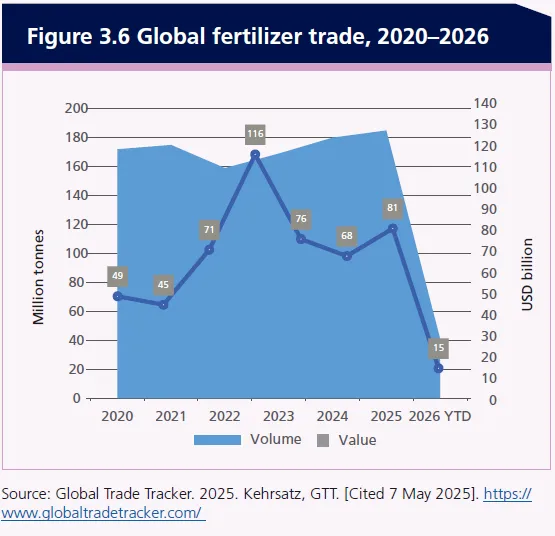
In 2025, total global fertilizer trade volume was 185 million tons, with trade value surging to 81 billion USD; from January—April 2026, total trade volume was 41 million tons, a decline from the same period last year, with rising fertilizer prices buffering the decline in trade value.
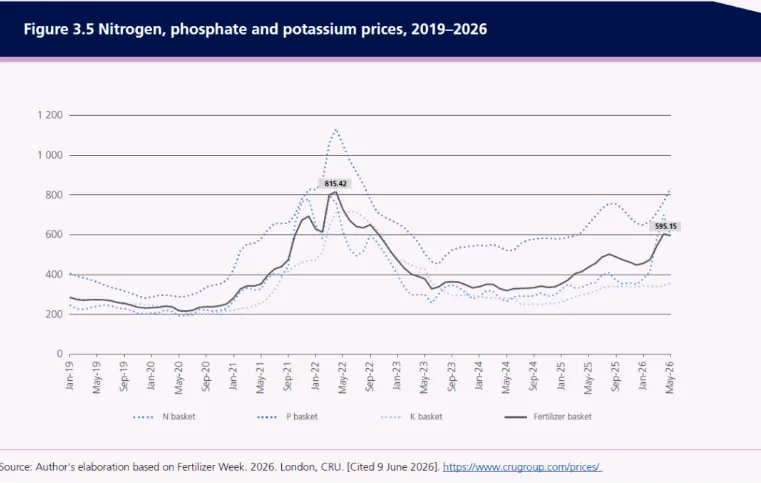
In terms of prices, fertilizer prices overall rose in the first half of 2026, with clear divergences across categories: nitrogen fertilizer prices showed signs of decline after a periodic surge; phosphate fertilizer prices remained firm, supported by tight raw material supply; potassium fertilizer prices rose relatively moderately due to low dependence on peripheral shipping routes.
IV. Market Outlook for June—November 2026
The report provides FAO's baseline assessment for the second half of the year: global logistics turnover efficiency will gradually recover, but the industry fundamentals of high energy costs and tight raw material supply are difficult to reverse in the short term, and the trends of the three major fertilizer categories continue to diverge:
1. Nitrogen Fertilizer:Along with Persian Gulf shippingWith the resumption of shipments and the orderly release of international supply through the implementation of China's export quotas, urea prices are expected to decline moderately. However, overseas facility operations and energy supply fluctuations will still cause periodic volatility.
2. Phosphate Fertilizer:With both raw material and finished product supplies remaining tight, the market's tight balance continues, prices will remain high, and there is room for further increase. Major demand markets such as India and Brazil face the risk of demand contraction due to high prices.
3. Potassium Fertilizer:The slow pace of new capacity release, combined with stable planting demand in Southeast Asia, supports a slight upward trend in the market; Europe, affected by sanctions, is purchasing Canadian fertilizers, with long-distance imports driving up overall logistics costs.
In the long term, energy price fluctuations, restructuring of global circulation, and countries' normalized import and export regulations will become long-standing development backdrops for the industry. Low-carbon production and diversified supply chain layout are the core directions for high-quality industrial development.

.webp)