





.webp)
.webp)

.webp)

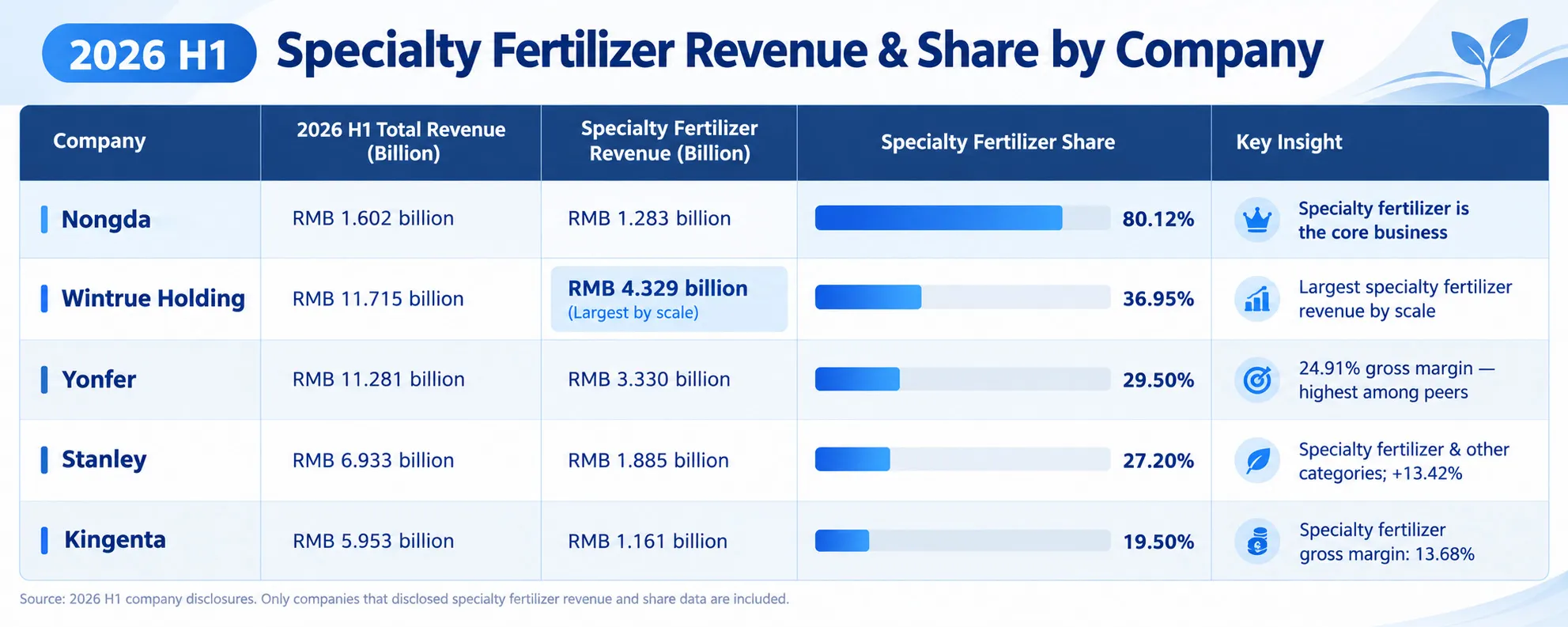
As conventional compound fertilizers struggle with gross margins below 10%—or dip into outright losses—the crop nutrition sector is undergoing a quiet, structural transformation. Driven by tight farm budgets and changing soil requirements, high-efficiency functional fertilizers are taking over the industry' s profit pool.
First-half 2026 financial results from major Chinese producers highlight a clear trend: companies completing the portfolio transition first are gaining significant pricing power and unit-level profitability.
The Margin Divide: Scale vs. Specialization
The shift is splitting producers into distinct strategic profiles:
•Nongda Fertilizer represents the purest play in this transformation, deriving over 80% of its revenue from specialty products. Driven by humic-acid functional fertilizers, water-soluble fertilizers (WSF), and microbial inoculants, Nongda prioritizes narrow-and-deep product specialization over sheer mass volume.
The Scale Transformers:
Major integrated manufacturers are using traditional compound fertilizers to cover base volume and fixed overhead while relying on specialty formulations to expansion-drive profit margins:
•Wintrue Holding: Leads the sector in sheer scale, recording RMB 4.329 billion in specialty revenue (~36.95% of total mix), with specialty compound sales growing 13.96% YoY.
•Yonfer: Demonstrates the starkest profitability gap—reporting RMB 3.330 billion in specialty compound sales at a 24.91% gross margin, compared to just 12.66% for its standard compound lines.
•China XLX Fertiliser: Commands premium pricing for functional upgrades, selling flagship humic-acid urea at a ~RMB 700/tonne premium and high-efficiency formulations at a RMB 400/tonne premium (volume up 24% YoY).
•Stanley Agriculture Group: Booked RMB 1.885 billion in specialty products (up 13.42% YoY), making it the company’s fastest-growing line.
•Sinofert Holdings: Expanded core foliar and microbial inoculants by 26% YoY, reaching 53,000 tonnes.
What It Means for the Sector
The incentive driving this product-mix evolution is straightforward: achieving nearly double the gross profit on equivalent sales volumes.
While specialty products require higher distributor education and agronomic support, their 17–25% gross margin profile offers the clearest path forward in a challenging ag-inputs environment. As standard fertilizers face overcapacity risks, early-moving specialty formulators are positioning themselves to control pricing power when the next cycle turns.
.webp)