





.webp)
.webp)

.webp)
On September 13, Beijing Leili Group signed a strategic cooperation memorandum of understanding (MOU) with the Indonesia Seaweed Association at Leili' s Beijing headquarters.
Just days earlier, on September 10-11, Bill Duan, General Manager of Leili, delivered a keynote address at the Global Forum on "One Country One Priority Product" Action for Promoting the Technologies of Dry-land Farming and Saline-alkali Land Reclamation held in Dunhuang, Gansu Province. During his speech, he laid out the company' s full suite of practical solutions for dry-land and saline-alkali land improvement.
On the day of the MOU signing, Mr. Sarfari Azis, President of the Indonesia Seaweed Association, and Mr. Wu Yuzhang, Deputy Secretary-General of the China Algae Industry Association, led a delegation on-site to Leili' s headquarters. The China Algae Industry Association facilitated this engagement.
The two sides held discussions covering sustainable seaweed harvesting, raw material standards, introduction and cultivation of new varieties, blue carbon sink R&D, talent development, and upgrades to deep-processing capabilities.
Leili has not yet released details on specific product categories, raw material volumes or timelines for future joint work.
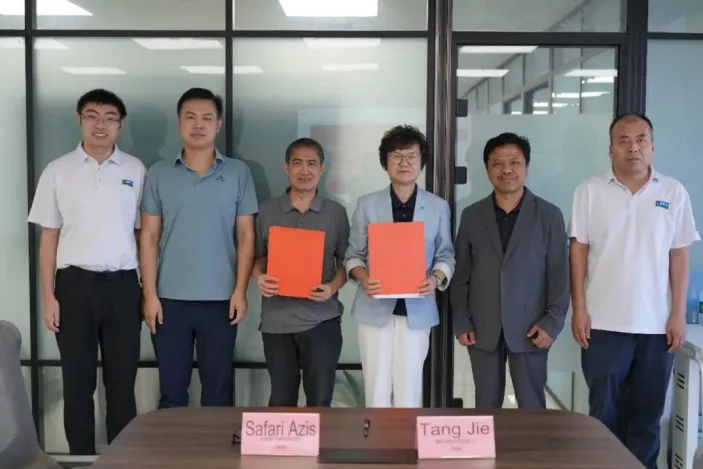
Group photo after the September 13 MOU signing between Leili and the Indonesia Seaweed Association. Mr. Sarfari Azis, President of the Indonesia Seaweed Association (third from left); Ms. Tang Jie, Chairperson of Leili (fourth from left).
Founded in 1993, Leili counts Leili 2000, a water-soluble seaweed fertilizer, among its flagship offerings. According to the company, its technology portfolio covers four core pillars: enzymatic hydrolysis, engineered microbial strains, nano-delivery systems and small-molecule peptide extraction. Its product lineup spans algae-based biostimulants and microbial inoculants to soil-amending solutions, and extends further into raw materials for human health and wellness, such as fucoidan and alginate oligosaccharides.
Co-hosted by the Food and Agriculture Organization of the United Nations (FAO) and China Agricultural University, the Dunhuang forum centered on agriculture in arid and semi‑arid regions and the comprehensive management of saline-alkali land. According to Leili, the company serves as a cooperative partner for FAO' s "One Country One Priority Product" initiative. At the event, Bill Duan, General Manager of Leili, outlined the company' s three sets of solutions for dry-land and saline-alkali land: seaweed polysaccharide-based soil remediation, the algae-microbe synergistic system combining seaweed polysaccharides and microorganisms, and seaweed-based biological water-retaining agents.
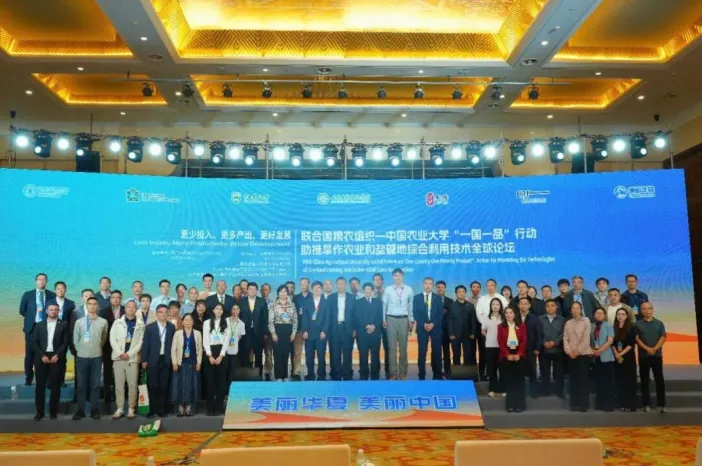
Scene from the Global Forum under the "One Country One Priority Product" initiative
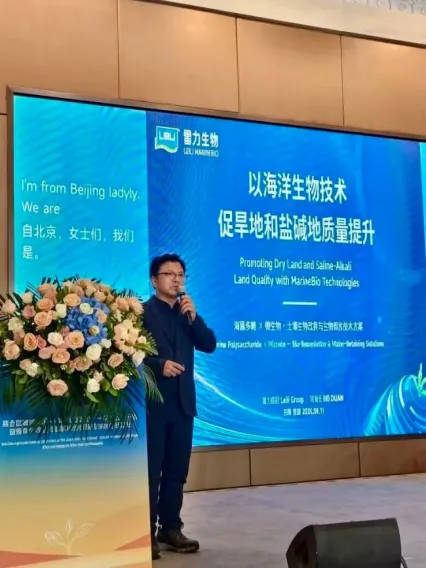
Bill Duan, General Manager of Beijing Leili Group, delivers a keynote speech at the forum venue
Leili shared a set of saline-alkali land improvement data sourced from the ″Saline-Alkali Land Improvement Trial in Wensu County″. The field trial was carried out in saline-alkali vineyards in Wensu County, Xinjiang.
After berry setting, the poly-amino acid calcium soil amendment was applied four times via drip irrigation at one-week intervals. The vineyard carried out all standard agronomic practices including regular fertilization, irrigation, pesticide spraying and weeding throughout the trial period.
Two months later, measurements showed surface-soil salinity dropped by roughly 30% and electrical conductivity (EC) fell by around 40%, compared with pre-improvement soil readings. Sourced from the same dataset, the trial covered 100 mu (≈6.67 hectares) of Cabernet Sauvignon wine grapes. Yields doubled compared with the same vineyard before the amendment was applied, which was a before-and-after comparison.
The Sichuan dataset dates back to an earlier period. Between 2012 and 2014, Shuangliu County ran a research-and-demonstration project titled ″Research and Demonstration on Improving Cultivated-Land Quality Using Marine Polysaccharides and Microbial Inoculants″. Baseline soil measurements were taken each year, with 20 monitoring sites set up to track land quality dynamically. Comparisons were made across the three-year trial period.
According to documentation provided by Leili, soil fertility improved markedly over the three years. Average crop yields rose by 16%, with vegetable yields jumping 33%. Soil organic matter registered a cumulative 27% increase over the three-year timeframe.
When it comes to water-retaining agents, Leili states the product achieves a maximum water-absorption capacity of 700-fold. This figure was measured in accordance with Appendix A of standard NY/T 886‑2022, using Grade-3 water specified under GB/T 6682 (deionized or distilled water). The test procedure is as follows: one gram of sample is weighed out, mixed with 1000 mL of Grade-3 water and stirred for five minutes. The mixture then sits for 30 minutes to allow full water absorption and swelling. The resulting gel is transferred onto a standard test sieve with a 0.18-mm aperture for gravity filtration over 10 minutes. Weight readings are then used for calculation following the official standard formula. In other words, the 700-fold rating is obtained under pure-water test conditions. Leili also notes that for saline-alkali environments, separate testing is performed using a 0.9% sodium chloride solution, with a minimum performance requirement of no less than 30 g/g.
Globally, Leili reports its market reach extends to more than 80 countries. Its products have been applied to date palms in Iraq, Saudi Arabia and Egypt, as well as specialty crops including sweet cherries in Uzbekistan, mangoes in Cambodia and chestnuts in Albania.
Within the EU market, Leili’s Alga600 and Alga300 are seaweed-derived biostimulants manufactured from sargassum via enzymatic hydrolysis. Both products hold EU type‑examination certificates (Module B) issued by CerTrust (NB 2806) under the EU Fertilizing Products Regulation (EU) 2019/1009. They fall under product function category PFC 6(B), defined as non-microbial plant biostimulants. The certificate lists Beijing Leili Marine BioIndustry Inc. as the manufacturer.Alga600 carries certificate number FB 009788 001, issued on November 25, 2024 and valid until November 25, 2029. Alga300 has certificate number FB 011654 001, issued on September 12, 2025 and valid until September 12, 2030.
Leili states it will leverage the "One Country One Priority Product" initiative and South‑South Cooperation platforms to roll out its relevant solutions across arid and semi-arid zones in Central Asia, West Asia and Africa. The company will also advance raw material and standardization cooperation with its Indonesian partners.
Source: AgroPages
.webp)